
Summary – Driving distances between major Namibia destinations
Namibia is a big country. The spaces between famous destinations are long — in some cases longer than you might expect. A 14-day self-drive safari means you will spend time in the car as much as on safari roads.
For example:
- Windhoek to Sossusvlei is about 350–380 km and can take around 4–6 hours on a mix of paved and gravel roads.
- Sossusvlei to Swakopmund is around 340–350 km and often takes 5 hours of driving.
- Swakopmund to Etosha (or Walvis Bay/Swakopmund to Etosha village) can be 540–570 km and about 7–8 hours on the road.
- Windhoek to Etosha is often around 400–450 km, about 5–6 hours of driving.
Longer legs like Windhoek to Fish River Canyon or Windhoek to Luderitz stretch that travel time even more — up to 8–13 hours in a single day if you do it all at once.
What this means for your planning is that many days will include long drives between attractions. One or two days will be travel days. You’ll want to plan stops for fuel, food, photos or views. And you’ll want to reach your next stop early enough to relax, eat, and rest ahead of the next stretch.
Here’s a clear list of distance and time facts from human sources you can refer to when you decide on your route.
For a full step-by-step guide, see our complete Namibia Camping Safari Guide
Driving Distances & Times
Windhoek (capital) to Major Sites
- Windhoek → Sossusvlei area: about 350–380 km and roughly 4–6 hours drive on a mix of tar and gravel roads. The desert road is scenic but can slow you down.
- Windhoek → Etosha National Park: around 400–450 km, taking about 5–6 hours on tarred roads.
- Windhoek → Swakopmund: roughly 360 km, around 5 hours on tar roads most of the way.
- Windhoek → Fish River Canyon: about 670 km and around 8 hours driving time. Good to plan for an overnight stop or early start.
- Windhoek → Rundu (Caprivi): approximately 710 km and about 7–8 hours on tar roads extending north.
- Windhoek → Katima Mulilo (East Caprivi): more than 1200 km, taking 13–14 hours if done in one day (not usually recommended).
Between Tourist Regions
- Sossusvlei → Swakopmund: about 340–350 km, often 5–6 hours on gravel roads with scenic stops.
- Swakopmund → Etosha (via Walvis Bay or directly): approximately 540–570 km and about 7–8 hours drive. This long haul merits an early start.
- Etosha → Damaraland: around 400 km and about 6–7 hours on gravel and tar, depending on your exact start and end points.
- Swakopmund → Sossusvlei (alternate route): similar distance (~350 km) and around 6+ hours if you drive without stopping.
- Sossusvlei → Fish River Canyon (long southern stretch): roughly 650–660 km and 9–10 hours on tar and gravel when you do the long down-country run.
Loop and Circuit Tips
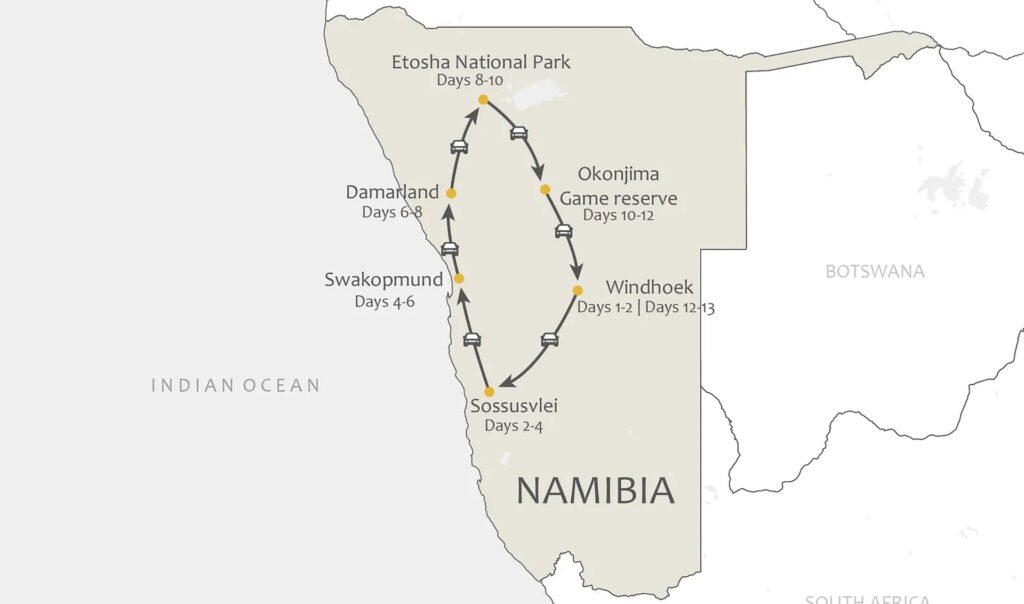
- Many travel planners suggest the classic Windhoek → Sossusvlei → Swakopmund → Damaraland → Etosha → Windhoek loop for a 14-day safari. Driving distances add up, so you often break this loop into manageable sections with overnight stops.
- In self-drive planning guides, drivers note that Google Maps often shows shorter times than real conditions because gravel roads and slower speed limits (like 80 km/h on gravel) change the real duration. Allow extra time.
Inside National Parks and Nearby
- Within Etosha itself, moving between camps and waterholes can take 1–2 hours for short distances like from Okaukuejo to Halali camp (~70 km). These drives are scenic and part of the wildlife experience.
About These Distances
When i first planned out my Namibia route, i had this idea that i’d zip from one place to the next and have lots of time at each. The reality was that days of pure driving became part of the rhythm of the trip. Some days felt long — especially Windhoek to Sossusvlei or Swakopmund to Etosha — but those drives were as much part of the safari as the game drives and dune climbs.
I learned to start early, fill up fuel and water before long legs, and give space for unplanned stops. A bird here, a camel thorn tree there, a dust road that makes you slow down and take in the silence — those moments matter.
So when you look at these distances, give them room. Plan your days so that you’re not just in the car. Split big legs into smaller ones if you can. And accept that long drives are part of the character of a Namibia self-drive experience.
Quick Fact Checklist — Namibia Distances
- Windhoek → Sossusvlei: ~350–380 km, ~4–6 hours drive.
- Sossusvlei → Swakopmund: ~340–350 km, ~5–6 hours.
- Swakopmund → Etosha: ~540–570 km, ~7–8 hours.
- Windhoek → Etosha: ~400–450 km, ~5–6 hours.
- Etosha → Damaraland: ~400 km, ~6–7 hours.
- Windhoek → Fish River Canyon: ~670 km, ~8 hours.
- Long southern legs like Sossusvlei → Fish River: ~650–660 km, ~9–10 hours.
Enjoy the freedom to explore Namibia. We provide travellers with a unforgettable self-drive camping safari across Namibia. Our services include trip planning, campsite booking and 24/7 support. We organise fully equipped 4×4 vehicles, rooftop tents, camping equipment, and practical travel support. Our travellers get clear routes, real driving distances, and realistic time planning. No rush. No pressure. Just solid travel planning.
We focus on budget-friendly self-drive camping safaris that still feel safe and well prepared, supporting eco-friendly travel (sustainable self-drive camping safaris). We share real local advice. If a tyre blows or plans change, we’re there to help.
Our team lives and works in Namibia. We know the gravel roads, fuel stops, weather, and wildlife areas. We build routes that make sense and keep the distances realistic. You travel at your own pace, sleep under the stars, and enjoy the freedom.
Let us arrange your camping safari. Join us for an adventure, turning photos into memories.
For a full step-by-step guide, see our complete Namibia Camping Safari Guide